
“Most of today’s institutional failures don’t begin with bad intent or poor data. They begin with a false sense of understanding Human Behavior.”
Investors, politicians, and business leaders rely heavily on traditional market research, risk assessments, focus groups, surveys, and polls to try to understand what people think and how they behave. Campaigns use polling, marketing firms use surveys to track brand sentiment, and governments rely on classified intelligence briefs. Hundreds of man-hours are spent sifting through reports and running models to create powerpoint briefs and pitch decks that contain fancy graphs, charts, and executive summaries, which look impressive, however they consistently fail to understand how people think and behave in ways AI models can’t anticipate.
Polls capture a snapshot in time of a preference, not a fundamental belief. Market research explains purchasing behavior after the fact, not before it shifts. Traditional risk analysis assumes rational actors responding predictably to incentives, rather then an individual’s world views. None of these methods or tools are built to measure how identity, emotion, and narrative interact in real time to drive behavior.
“That gap is no longer theoretical. It is operational.”
In the upcoming Harris County’s midterm elections, voter perceptions and turnout will be driven less by candidate platforms and more by voter confidence in the process. Official narratives focus on procedure and compliance however, voters interpret the same messages through a lens of rights, fairness, and historical grievance. Polls that identify partisan alignment miss the deeper signal: cynicism and resignation spreading among voters who still care enough to engage, but no longer believe outcomes are legitimate.
The same blind spot appears in markets research. ENODO’s analysis of Cuisine Solutions, revealed how traditional research could not explain industry growth rates and consumer demand. It could not explain was why a global food company could enjoy strong demand while remaining largely invisible to consumers or why brand visibility could become a risk. ENODO’s IaaS Behavioral Intelligence revealed a stable identity environment where consumers rewarded consistency and safety while quietly resisting overt industrial branding. That insight, which does not appear in traditional market research is invaluable for accurate valuations, expansion strategy, and M&A timing.
Governments experience this disconnect more frequently and acutely. When Japan’s Prime Minister described a Taiwan blockade as a “survival-threatening situation,” the statement was intended as strategic realism. Japanese citizens interpreted the same message from an entirely different world view and logic of appropriateness. Behavioral analysis showed how the remarks activated household-level fears tied to food scarcity, energy shortages, and historical memories. The issue for citizens was not geopolitics; it was survival. Traditional security analysis could not see that fracture forming in real time that behavioral intelligence did.
“These failures are not accidental. They are structural.”
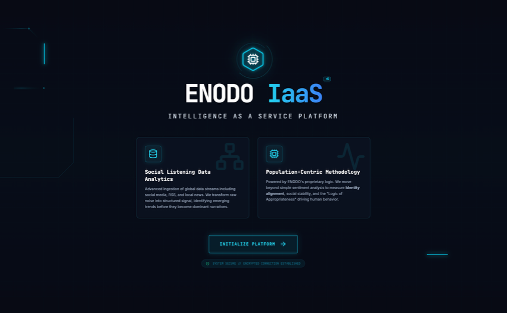
ENODO’s Intelligence-as-a-Service (IaaS) platform was built to address this problem. Its origins are not in marketing or data science, but in military Information Operations (IO) and psychological Operations (PSYOPS) where understanding how populations interpret events can determine success or failure before kinetic action occurs. The platform was designed to answer questions traditional tools cannot: What narratives are forming, which identities are being activated, how fast are beliefs hardening, and where is confidence eroding before behavior changes?
IaaS operates continuously, ingesting global discussions across social media, news, and local, regional, and international sources. It does not measure sentiment as static or binary number. It measures the emotional intensity, momentum, and alignment of narratives with identity to forecast behavior through the lens of an individual, community, or population. It reveals how narratives emerge, spread, and compete but most importantly, it quantifies behavior and beliefs, which enables leaders to see when an environment is resilient and when it is nearing a tipping point.
The Masajid Al Freej initiative in the UAE illustrates this distinction clearly. Traditional ESG or CSR metrics confirmed positive sentiment associated with architectural quality, sustainability features, and funding alignment. Behavioral intelligence revealed something much deeper: a highly stable identity environment where the initiative reinforced national pride and social cohesion. It also uncovered subtle community-level expectations around accessibility and daily utility ties to the program’s legitimacy and how they affirmed cultural meaning; a key factor in the project’s long-term success.
Across elections, financial markets, geopolitics, and community investment there is a clear and consistent pattern developing. Organizations fail to optimize their investments or achieve their objectives because they misunderstand how people interpret the world around them. ENODO’s IaaS platform allows leaders to proactively design and execute communication and engagement strategies before risk becomes visible. It gives decision-makers a way to see and understand he “Human Terrain” they are operating in before trust erodes and their brand or policy hardens into resistance.
In an era defined by volatility, legitimacy crises, and rapid narrative shifts, understanding people is no longer a soft skill. It is core competency required to manage “Social Risk.” ENODO’s Behavioral intelligence is the difference between reacting to events and shaping the conditions under which those events unfold.
Contact info@enodoglobal.com to schedule a free platform demo.